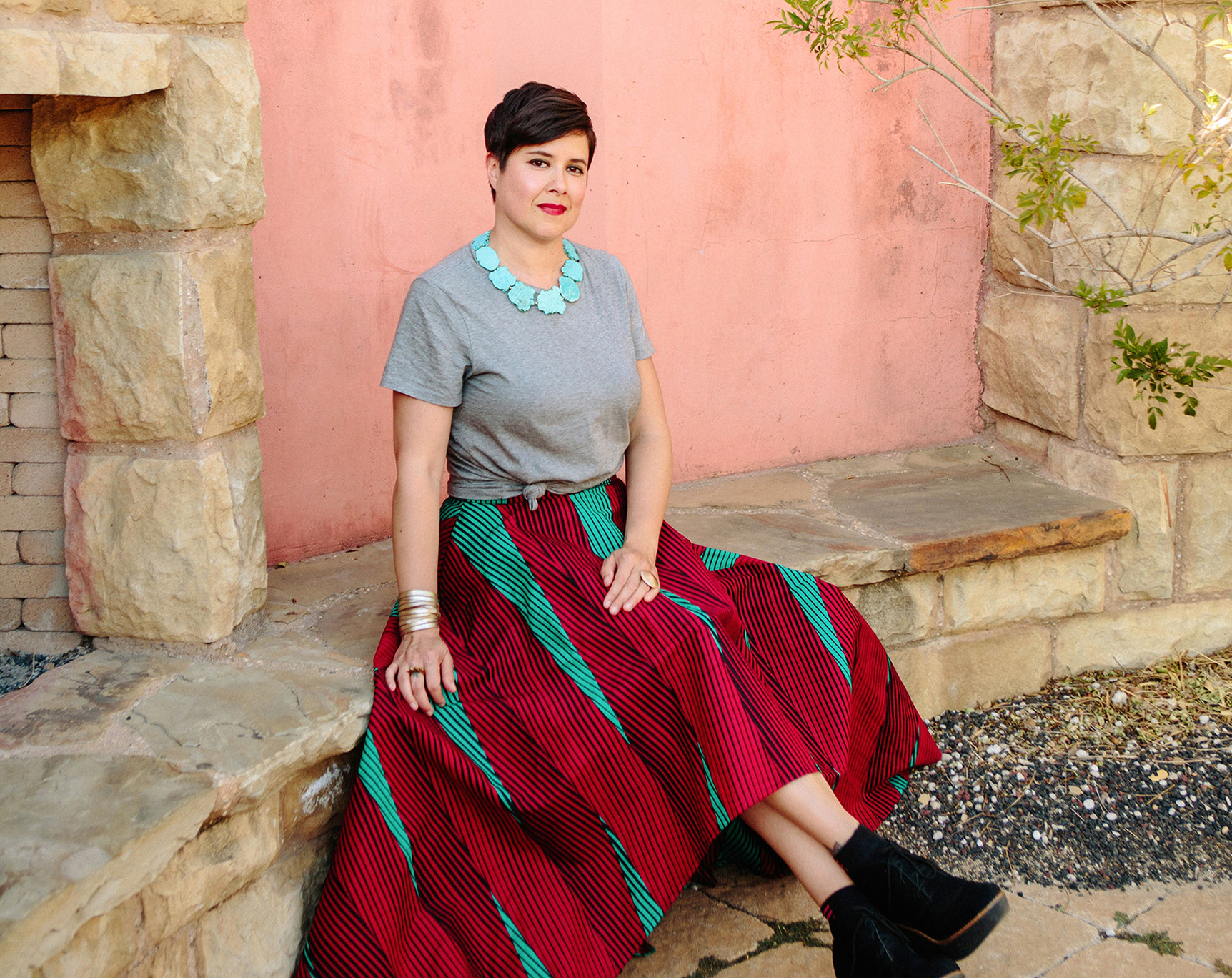
Between two skies, one Californian and one Mexican, Sandra Velásquez learned that identity is not explained; it is felt on the skin. The daughter of Mexican immigrants, born in San Diego, she grew up in that space where borders do not separate but teach you to look from both sides.
In 2020, from her apartment in Brooklyn, she founded Nopalera, a personal care brand that transformed a national symbol into a contemporary ritual. Her inspiration was the nopal, the cactus of the Mexican desert, with thorns on the outside and luminous sap on the inside, a plant capable of surviving under the highest sun and continuing to bloom.
Author: Claudia Valdez
In Mexico, the nopal is food, medicine, and metaphor
Its pulp, rich in antioxidants and vitamins A, C, and E, hydrates, soothes, and strengthens the skin.
In Velásquez’s hands, that ancestral energy became art: soaps, creams, scrubs, and candles that breathe the spirit of the earth.
Each Nopalera product is inspired by the tones and aromas of the Mexican landscape, ochres, dry greens, desert dust, the humidity of the cactus, the echo of rain over the soil.
Its formulas evoke belonging: they are a return to the essential, to what existed before trends and discourse.
“The nopal has always been here, strong, beautiful, resilient, just like us.”
Nopalera does not seek to represent everyone, but to remind the world that what is Mexican does not need translation to be sophisticated.
With presence in Ulta Beauty in the United States and Mexico, the brand does not sell exoticism: it sells truth.
And in that truth, authentic, austere, powerful, lies the new language of luxury.
SANDRA VELÁSQUEZ FOR ttt

1. TTT: Your story is not about conquest or resistance, but about construction. When did you understand that your identity was not a border, but an architecture you could design?
S.V: I grew up with one foot here and one there. My parents were always proud to be Mexican, and their environment was very diverse. That mix was my normal. I believe we all have the opportunity to connect with our heritage or ignore it; I was lucky to grow up with that pride as my starting point.
2. TTT: Creation does not always arise from an idea; sometimes it is born from a void. What space did you want to fill when you imagined Nopalera?
S.V: I call it the “brownspace,” because in business everyone talks about the “whitespace.” There were no premium Latina brands on the shelves. I wanted to challenge the idea that everything Mexican had to be cheap. I believed, and still believe, that we deserve a range of products that represent our culture, from the most accessible to the most sophisticated.
“I call it the brownspace, that space no one named, because in business everyone talks about the whitespace.”
With that phrase, Velásquez not only created a brand: she opened a cultural space. A place where representation stops being a claim and becomes creation.
“ My purpose is for people to feel proud of who they are.”
3. TTT: There is an elegance in Nopalera that does not ask for permission. How did you find that voice that does not shout, but imposes?
S.V: From the beginning, I wanted to create a bold and elevated Latina brand. I have never been one to ask for permission. My intention was to build something strong, visually powerful, that even those who did not know what a nopal was would want to be part of it.
“I have never been the kind of woman who asks for permission.”
A phrase that synthesizes her leadership: creating from conviction, not from validation.
4. TTT: You have said that heritage is not a weight but an impulse. What part of that heritage guides the way you lead and decide?
S.V: My purpose is for people to feel proud of who they are. It hurts me when people feel they have to assimilate or hide in order to belong. That is learned behavior, often rooted in survival. But I want to inspire others to be exactly who they are, without apologizing for it.
“We were not born lesser, there was never anything to correct in us.”
A statement that sounds more like a manifesto than an answer. A line that could be engraved on the skin of an entire generation.


5. TTT: Leading as a Latina founder implies balancing vulnerability and control. How do you manage to hold both without one canceling the other?
S.V: I have been very open with my building process, that is the vulnerable part. But what I protect most is the authenticity of the brand. Nothing can compromise that.
6. TTT: What does it mean to you to know that Nopalera no longer belongs only to you, but to an entire community that sees itself reflected in it?
S.V: From the beginning, Nopalera was about the community. I am just the messenger. In one hundred years, no one will remember my name, but I hope the brand continues to exist and leave a mark.
7. TTT: If Nopalera were a letter to the future, written by one woman to those who come after, what would its first lines be?
S.V: “ “Your greatest asset is you. Self-worth is an inner knowing. Once you recognize it, no one can take it away.”
“Your greatest asset is you. Self-worth is an inner knowing. Once you recognize it, no one can take it away.”
VOICE OF THE EARTH
In a world where strategy often disguises itself as identity, Sandra Velásquez chose truth.
Nopalera was not born to represent, but to remember. Its success is not measured in figures or launches, but in something deeper: the reunion of a community with its reflection.
Velásquez does not compete for space: she inhabits it with purpose.
And in that calm lies her strength, that of a woman who turns roots into a silent revolution. Because some stories do not need to shout to transform.
They only need to be spoken with the voice of the earth.