The conversation that always existed, but is only now allowed to breathe
For generations, motherhood was assumed to be an inevitable destiny. It wasn’t an option, it was a natural sequence, an expected step, a marker of identity. Social narratives dictated that reaching motherhood completed a woman’s life; everything before it was preparation, a meantime, or an exception.
But reality, silenced for decades, now emerges clearly: not all women want to become mothers. And that fact, as human as any other, has always existed.
What changes now is that it can finally be said out loud without asking for permission.
The calling that never arrives: when absence becomes its own kind of certainty
For many women, not becoming a mother isn’t rejection, trauma, or ideology. It is simply a desire that never appeared. An inner calm that says, “this isn’t for me,” without pain, without anger, without drama.
But that personal tranquility becomes a burden when the world insists on seeing it as an anomaly. And the questions arrive in every conversation:
And you… when is your turn?
Are you trying yet?
Won’t you regret it?
What does your partner think?
What looks like “kindness” is, in reality, an intrusion. A question that ignores the fact that behind it there might be entirely different stories: women who do not want children, women who cannot have them, women who doubt, women who are healing, women who are living lives that cannot be measured through motherhood.
Motherhood is valuable, yes.
But it is not the only form of future.
Nor the only way to love.
Nor the only path to a full life.
The social script that persists: when everyone moves in the same direction
In many social circles, the rhythm seems pre-programmed: study, work, marry, have children. And the woman who doesn’t follow that cycle floats between two worlds. Not because her decision is wrong, but because society still doesn’t know what to do with a woman whose life project does not include motherhood.
Groups where all friends have children often become without intending to spaces where motherhood is the center. Those who aren’t there, even when present, can feel outside. Not for lack of love, but because the conversation shifts to a language they don’t speak.
Non-motherhood doesn’t mean being alone. But it does mean inhabiting a world that still isn’t designed to hold every form of female life.
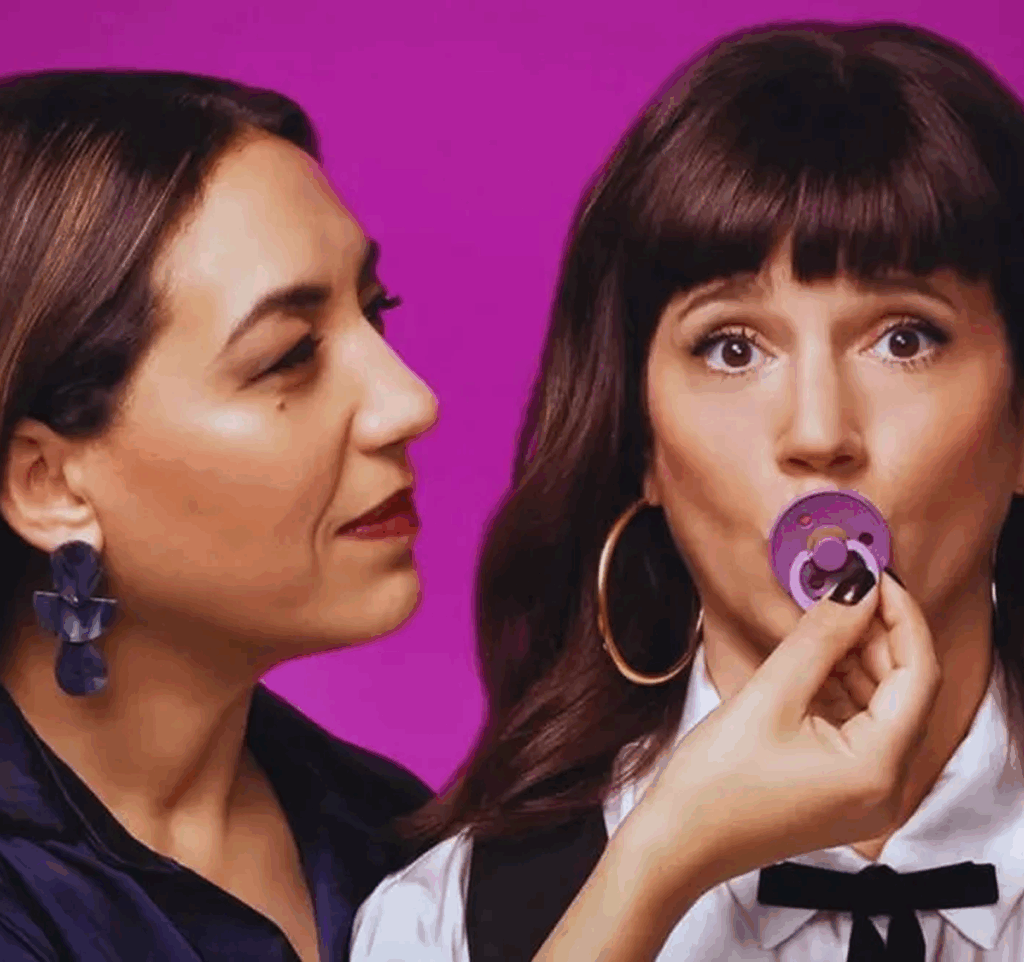
Fiction as catalyst: what ‘envidiosA’ reveals
In the Argentine series Envidiosa, available on Netflix and starring Griselda Siciliani, one of the most precise portrayals of this topic appears. Not because the protagonist, Vicky, openly says she doesn’t want to be a mother, but because of how she processes it with her therapist.
That nuance is essential.
Vicky doesn’t arrive at therapy broken, sad, or in inner conflict.
She arrives carrying something quieter: learned guilt.
Not her own guilt, but guilt imposed by a world that insists a woman without children is incomplete.
Throughout the series, we see Vicky living an expansive, passionate, meaningful professional life. That is her center. That is her life project. There, in her work, in her growth, in her self-development, is where she mothers. She creates, nurtures, builds, and expands through her career. That is her constant birth. And yet, she fears disappointing others.
She fears her truth will be seen as a flaw.
In one of the most powerful scenes, she confesses in therapy:
“It’s just not for me. I’m fulfilling myself… but I’m afraid they’ll leave me. Or that they’ll see me as a monster.”
The therapist then does something society rarely does:
she doesn’t question, correct, or label.
She clarifies.
She holds.
She humanizes.
She tells her, between the lines, that not feeling the calling is not a flaw, but a truth. That many women do not mother children, but paths, ideas, projects, entire worlds. That not all women are made to raise external life… some are made to raise their internal one.
And most importantly: that the calling will not arrive because it doesn’t live in her. And that is okay.
The series doesn’t offer a conclusion. It offers something more powerful: relief. And that relief becomes the emotional mirror of thousands of women.
The data confirms it: this is no longer an exception, it is a global shift
The transformation isn’t personal; it is collective. The numbers show it:
- In the United States, voluntary non-motherhood has tripled in five decades.
- In Europe, about 20% of women reach 40 without children.
- In Japan, 27% say they do not want motherhood.
- In Mexico, Argentina, Chile, and Uruguay, birth rates are at historic lows, while more women openly state they do not want children.
The reasons are multiple: new narratives of autonomy, delayed economic stability, housing crises, cultural shifts, new concepts of partnership, emotional awareness, alternative forms of fulfillment, reproductive freedom, and a profound redefinition of what it means to live a full life.
Motherhood is no longer the only path. And not being a mother is no longer synonymous with lack.

Three distinct realities that deserve equal respect
Talking about motherhood, and non-motherhood, is not drawing a dividing line. It is recognizing three equally valid experiences:
1. Women who can become mothers, and don’t want to.
They never felt the calling.
They are not incomplete.
They build deep, free, creative, meaningful lives.
2. Women who want to become mothers, but cannot.
They walk delicate processes that deserve empathy, not interrogation.
Their worth is not tied to their fertility.
3. Women who are unsure.
Ambivalence is deeply human.
Motherhood should never be chosen out of pressure, fear, age, tradition, or expectation.
The scientific lens: the maternal instinct is not universal
For years we were taught that the maternal instinct was automatic.
Science says otherwise.
Neuroscience shows that the desire to mother:
- Is not biological in all women.
- Is not programmed in the female DNA.
- Appears when there is vocation, not obligation.
Not feeling it does not mean lack. It means authenticity.

A new feminine narrative: respect, diversity, and inner freedom
Non-motherhood should not divide us.
It should unite us in something deeper: the right for every woman to live from her truth, without forced explanations.
Because life is born in countless places: a profession, a project, a work of art, a relationship, a journey, a community, an idea, personal growth, inner transformation.
Motherhood is one way to create life. Non-motherhood is another.
A necessary closing: may every woman find peace in who she is, not in what is expected of her
This text does not aim to convince anyone. It aims to make room.
For women who don’t want children to exist with dignity.
For those who do want them to be supported.
For those who cannot to be respected.
For those who doubt to be heard without pressure.
So that fulfillment no longer has a single shape.
The calling that never arrives is also an answer.
A real one.
A human one.
An adult one.
A deeply personal one.
And it deserves to exist with freedom, dignity, and peace.