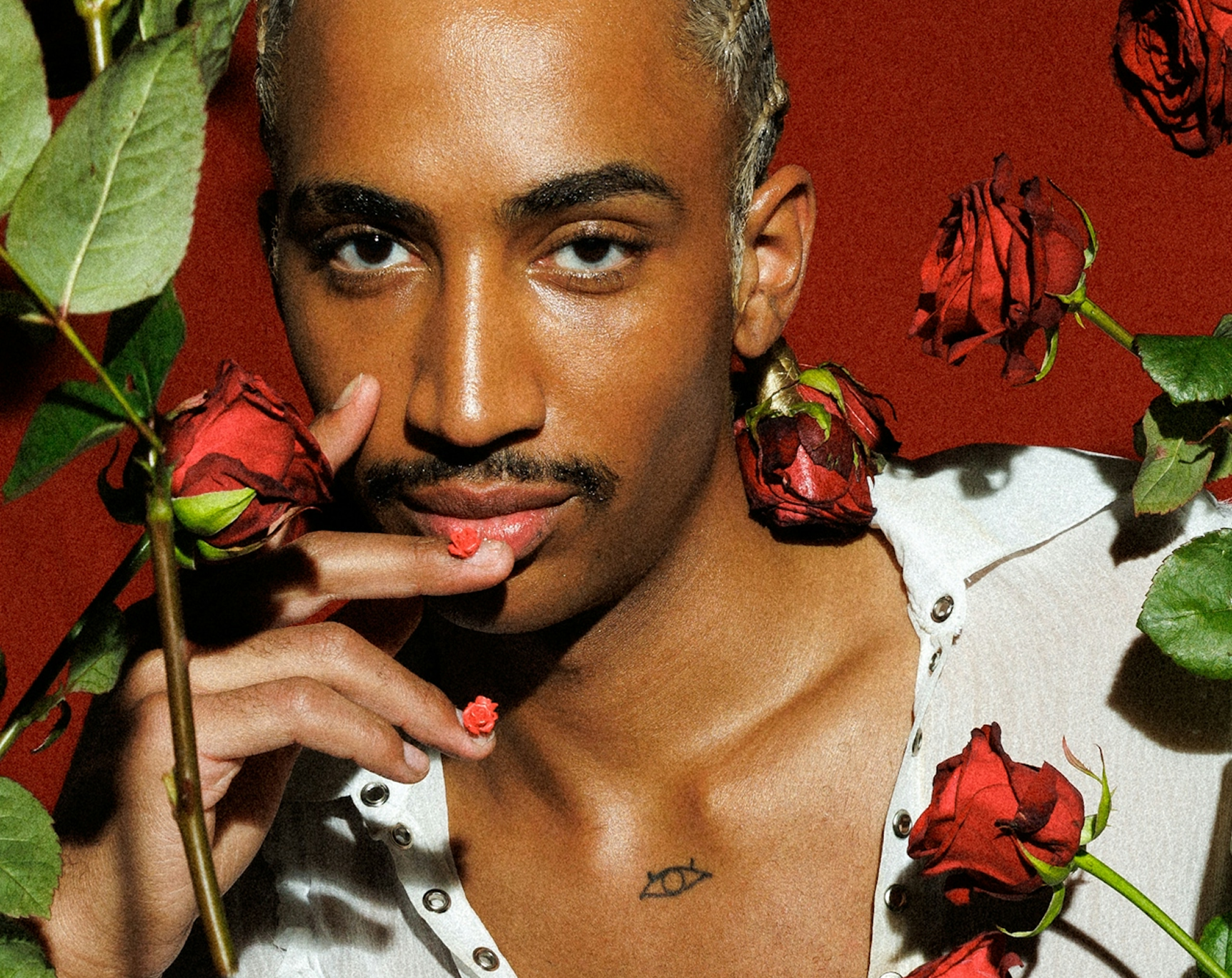
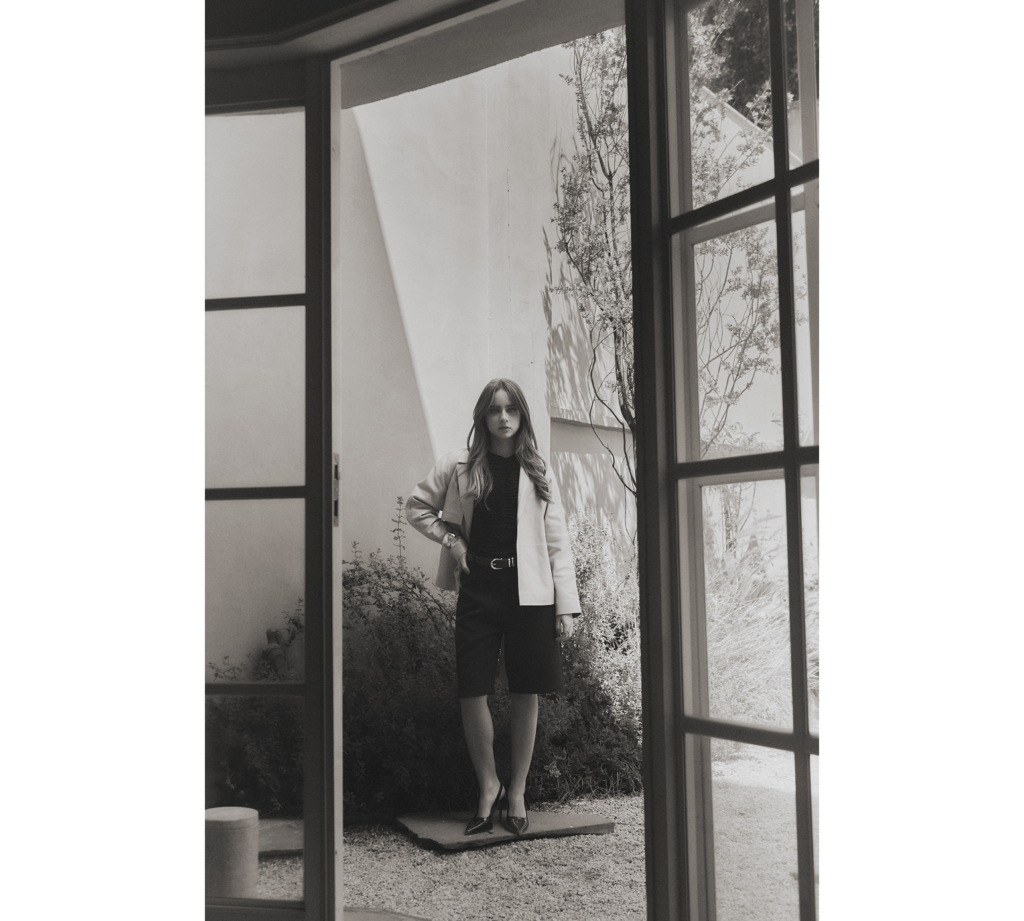
Azul Guaita has been in front of the camera from a very young age. Not as a sudden breakthrough or a recent discovery, but as a presence that has been built over time within a system that rarely pauses. Her career does not respond to a single moment or an obvious narrative, and perhaps that is why it does not need to explain itself from that place.
She belongs to a generation that learned the craft while practicing it. One that understood the rhythm of the industry from within, without enough distance to question it at the beginning. Projects that arrive, decisions that are made quickly, a continuity that is often mistaken for direction.
What becomes interesting is when that continuity stops being enough. Not necessarily outwardly, but in the way it is sustained.
Author: Claudia Valdez
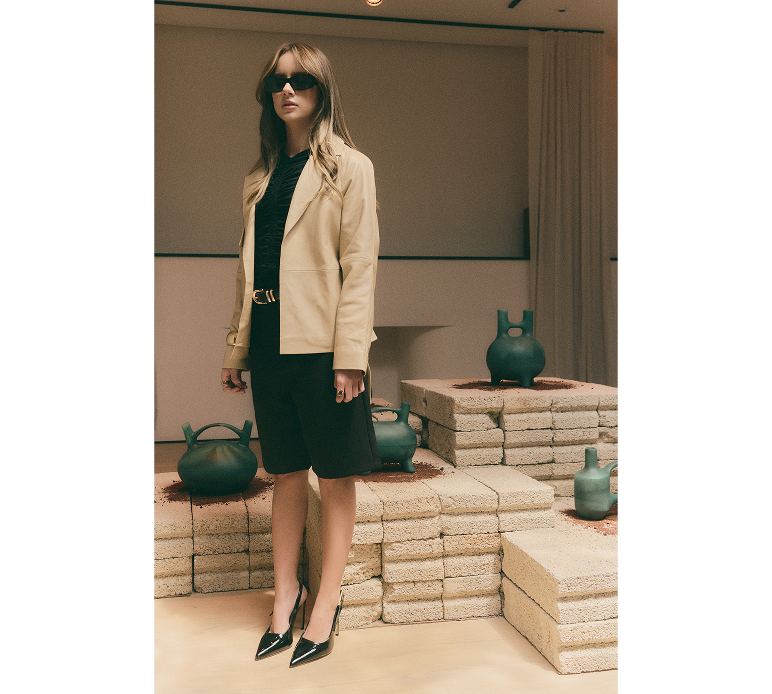
There is something that shifts in the way an actress relates to her work once she has been in it long enough to recognize what it means to remain. Decisions begin to carry a different weight. Not through strategy or discourse, but through a clarity that is not always announced, yet ultimately organizes everything else.
In Azul Guaita, that moment does not present itself as a rupture or a reinvention. There is no clear distance between what she has done and what comes next. But there is a way of moving that begins to feel more precise. In what she chooses, in what she lets go of, in how she inhabits a space that, for many, still feels temporary.
In an industry that privileges speed, that precision is not immediate. Nor is it obviously visible. But it is what ultimately determines whether a trajectory sustains itself or simply moves forward.
This conversation does not attempt to explain her or organize her career. It approaches, instead, an actress who understands the weight of what it means to be there, and who is beginning to decide how she wants to sustain it.
EXCLUSIVe INTERVIEW:
TTT: At what point did you begin making decisions based on the trajectory you want to build, rather than just the next project?
AG: I think that moment came when I realized that saying yes to everything can also be a way of losing direction. At the beginning, every project feels like an opportunity you cannot pass up, but over time you start to notice that saying yes to everything takes you further away from what you actually want to build. I started thinking about trajectory when I questioned whether what I was doing truly represented me or if it was simply keeping me in motion.
TTT: What defines, for you today, a project that is worth it?
AG: That it has a clear perspective. It does not necessarily have to be big, but it has to be honest in what it wants to say and in what it allows me to explore as an actress. I am interested in projects that do not exist just to fill a space, but that are trying to build something, even if that involves discomfort or stepping out of my comfort zone.
TTT: How do you identify when a character truly adds to your career and when it does not?
AG: When it demands something from me that I have not yet resolved. If I feel like I already know exactly how to approach it, then it is probably not moving me. What interests me is when a character challenges me, when it forces me to discover something new.
TTT: In an industry that constantly proposes paths, how do you decide which ones not to take?
AG: There are paths that can give you immediate visibility, but they can also place you within a narrative that you did not fully choose. I prefer to move more slowly, but with greater clarity about what I want to build.
TTT: How much control do you seek within a project?
AG: I do not seek absolute control, but I do need to feel aligned with what is being done. It is important for me to understand where the story is being told from and how the character is constructed within that universe.
TTT: Are you more interested in working under certain perspectives, directors or teams, rather than specific characters?
AG: Yes, because the same story can change completely depending on who is telling it. There are directors who allow you to inhabit a character in a different way, and that matters to me just as much as the character itself.
TTT: How do you build a character: from intuition, observation or a more technical structure?
AG: I start from intuition, but I try not to stay there. Intuition opens a door, but structure is what sustains the character when you are on set. I am interested in finding that balance, because without structure everything can become fragile.
TTT: Is there something you are no longer willing to negotiate as an actress?
It is very difficult for me to sustain a project if there is no real sense of teamwork. Beyond the character, I need to feel that there is a shared intention between the cast and the crew.
I began to think about trajectory when I questioned whether what I was doing truly represented me, or if it was simply keeping me in motion.
AZUL GUAITA
TTT: What have you learned about the craft that is not taught, but changes everything?
AG: That not everything needs to be proven. At the beginning there is a constant need to explain what you are building, but over time you learn to hold your decisions without needing to validate them all the time. That completely changes the way you stand in front of a character.
TTT: How do you prevent external perception from influencing your decisions?
AG: You cannot completely avoid it, but I try not to make decisions from that place. External perception changes all the time, and if you move based on that, it becomes very difficult to build something of your own.
TTT: Are you more interested in transforming with each project or building a recognizable identity?
AG: I think one leads to the other. If you truly transform, eventually something becomes recognizable, but not through repetition, rather through a way of working.
TTT: What kind of stories interest you today, and which ones no longer represent you?
AG: I am interested in stories that do not simplify characters, that allow contradiction. I find it increasingly difficult to connect with narratives that need everything to be clear or easy to consume.
TTT: How do you understand success at this stage of your career?
AG: As the ability to choose. Not in terms of quantity, but direction. Being able to say yes or no without that meaning disappearing.
There are paths that can give you immediate visibility, but they can also place you within a narrative that you did not fully choose.
AZUL GUAITA
TTT: When do you know a decision was the right one?
AG: You do not always know in the moment. Sometimes you understand it later, when you see where it took you. But when I make a decision, I trust a certain internal clarity.
TTT: And today, beyond what is visible, what are you building as an actress?
AG: A sense of criteria. Because in the end, beyond the projects, what truly remains is where you choose to act from.
CIERRE
What begins to take shape here is not a reinvention, nor a declaration. It is something quieter, but far more definitive. A way of understanding the work that does not depend on visibility, but on the clarity from which it is sustained.
Because in the end, a trajectory is not defined by the roles that accumulate, but by the decisions that remain.