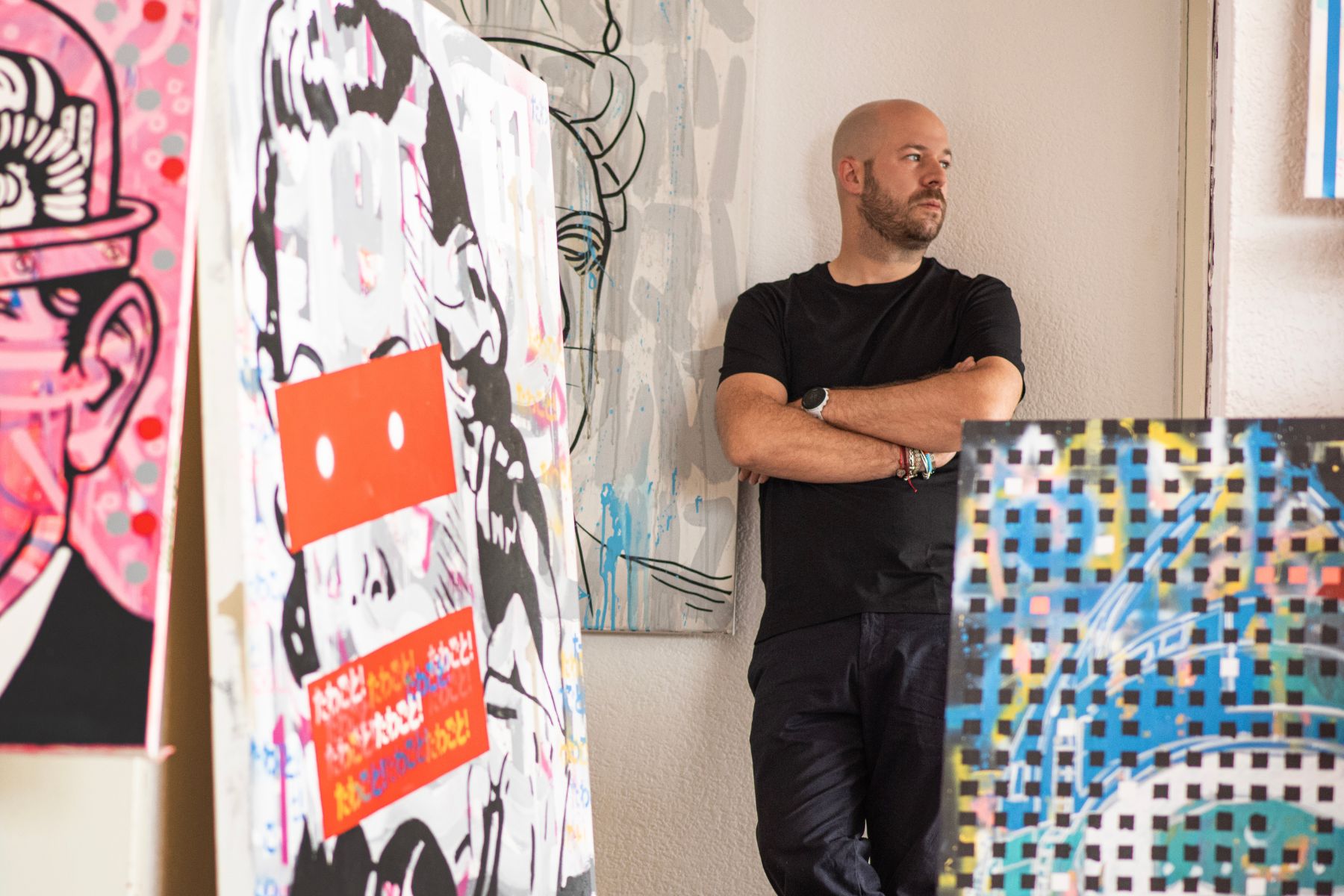
At first glance, AWOK’s work appears to be built on geometry. Precise lines, balanced compositions, and carefully structured forms create an immediate sense of order. Yet spending just a few moments with one of his pieces reveals that geometry is never the true subject. Behind every plane of color, every fragmented face, and every composition lies a much quieter pursuit: the construction of a visual identity.
Before dedicating himself entirely to painting, Miguel González built a career in interior architecture and 3D design. For years, composition, proportion, and balance served projects that were designed to solve practical problems. Those tools never disappeared when he picked up a paintbrush for the first time. They remain embedded in the way he understands space, color, and form; what changed was their purpose. Structure stopped solving problems and began provoking emotion.
The Architecture of a Visual Language
Living in Mexico for more than a decade also transformed his visual language. Rather than simply reshaping his color palette, the country broadened the way he understands the relationship between culture, environment, and identity. That influence naturally emerges in a body of work where design, architecture, and urban art are in constant dialogue without ever belonging entirely to any one of those disciplines.
At a time when images are produced at an unprecedented pace and artificial intelligence can replicate artistic styles with remarkable accuracy, AWOK’s work reminds us that artistic identity is not built solely through a recognizable aesthetic. It also grows out of lived experience, the places we inhabit, and a deeply personal way of interpreting the world.
In conversation with Topics That Transform, the Spanish artist reflects on the journey that led him from design to the canvas, the influence Mexico has had on his work, and what continues to make a human creation truly irreplaceable.
ttt exclusive
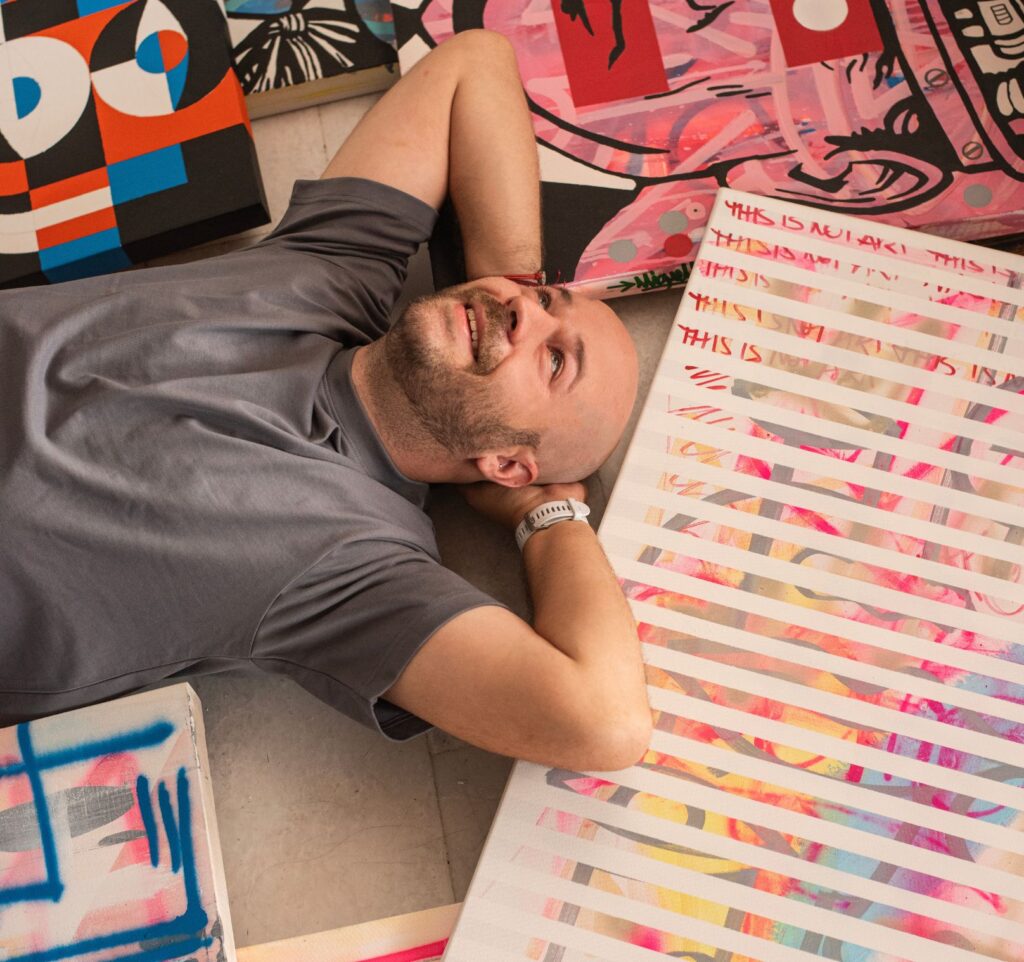
For years, you designed spaces for other people to inhabit. Today, you create works that every viewer interprets through their own personal story. What did you discover about yourself when you stopped designing for others and started painting for yourself?
Painting gave me something I could hardly find in design: absolute freedom. After years of developing projects shaped by clients’ needs and expectations, I found in the canvas a place where every decision depends solely on my intuition and creative vision.
Freedom emerges as a recurring theme throughout our conversation. It is not simply about creating without clients or constraints, but about developing a visual language that no longer needs to answer to anyone else’s perspective. In that sense, painting did not replace architecture; it simply transformed the purpose of the same creative tools.
After living in Mexico for more than a decade, it seems the country has transformed not only your color palette but also the way you observe the world. Is there anything today that has become impossible to separate from your work?
Mexico has been a constant source of inspiration. Its visual richness—from contemporary design to traditional expressions such as Huichol art—has transformed the way I understand color, composition, and space. The faces that appear throughout my work have also become an essential part of my visual language. Without them, I feel my work would lose part of its identity.
Every creative identity eventually absorbs the places where it develops. In AWOK’s case, Mexico ceased to be simply a place of residence and became part of his visual vocabulary. Its cultural references do not appear as direct quotations, but as a quiet presence that has naturally become part of his artistic language.
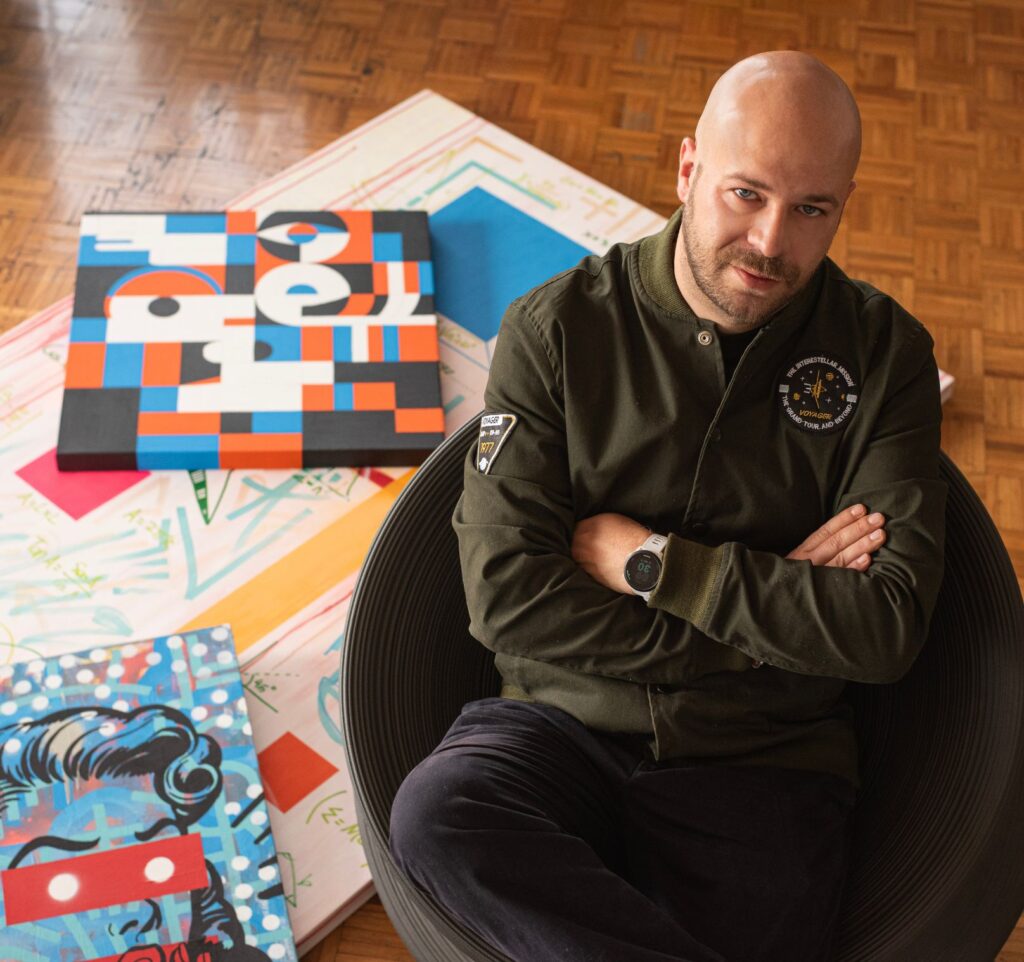
Painting gave me something I could hardly find in design: absolute freedom.
Geometry runs through much of your work, yet it never feels rigid. What does that visual language allow you to express that other forms of expression cannot?
Geometry allows me to create an ordered chaos, a balance where every element relates to another through the simplicity of line and color. It is a language that helps me communicate harmony within complexity.
Over time, my work has evolved into a much more refined visual language. Elements that have always been present—such as faces and geometric forms—now coexist with greater simplicity and coherence, allowing me to focus less on solving functional problems and more on provoking emotion.
Although geometry is often associated with precision and control, the opposite happens in AWOK’s paintings. The lines organize the composition, but emotion ultimately guides the work. Structure does not suppress spontaneity; it gives it direction.
We are living in a moment when artificial intelligence can learn and reproduce a visual style within seconds. Where do you believe the difference between an image and a work of art still exists?
What makes a work of art truly irreplaceable is the artist’s ability to convey emotion through a gesture, a brushstroke, or a single mark placed at exactly the right moment. That human and emotional dimension remains impossible to replicate.
The conversation inevitably turns toward one of the defining questions of our time: what it means to create in an era when technology can reproduce almost any visual language. For AWOK, the answer is not found in technique, but in something no tool can fully automate—the human experience behind every creative decision.
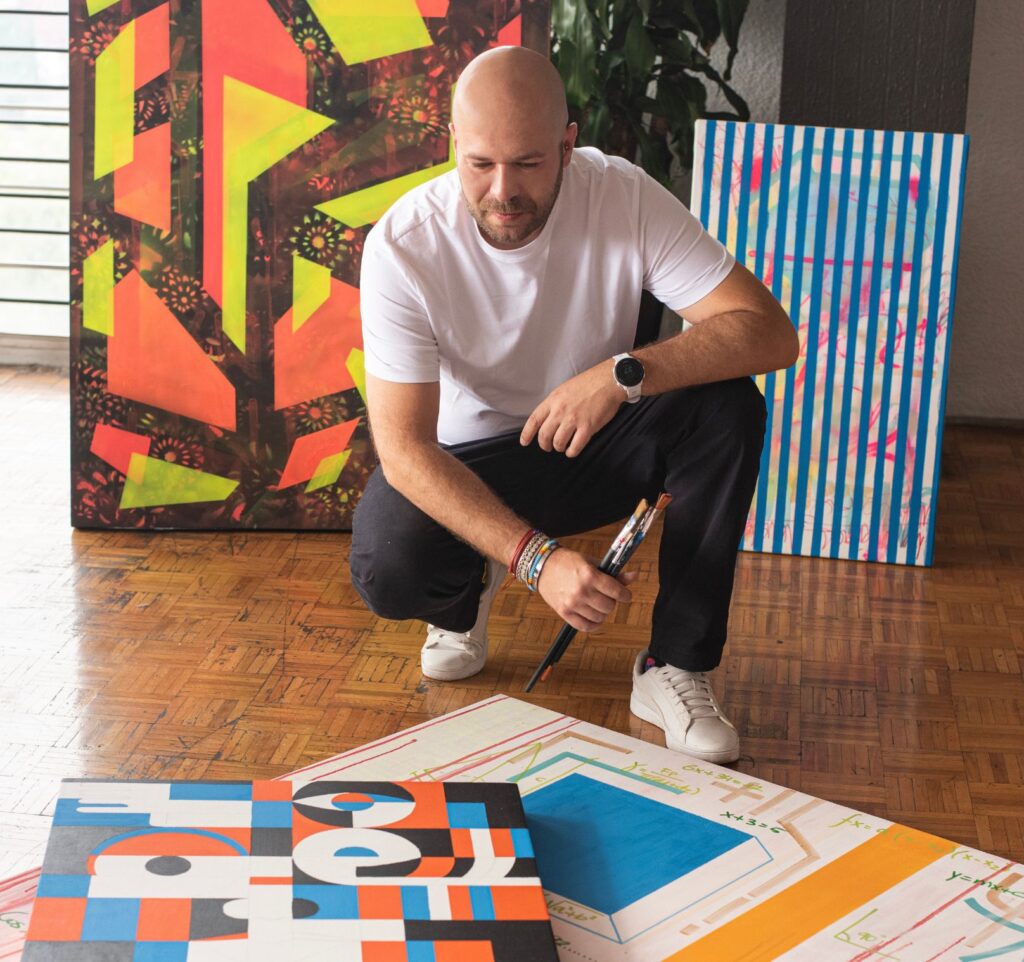
I hope to preserve exactly what I value most: my creative freedom and the essence that gives my work its identity.
Every artwork begins with an intention, but it ultimately acquires new meanings when someone else encounters it. Do you feel the need to control that interpretation, or do you enjoy allowing each viewer to discover something different?
I enjoy the fact that every viewer finds their own interpretation. I believe that freedom of interpretation enriches the work and allows each person to establish a unique relationship with it.
You are still writing the opening chapters of your artistic career. If you were to read this conversation again ten years from now, what would you hope had changed, and what would you hope remained exactly the same?
I hope that, in ten years, my work will have gained broader international recognition. At the same time, I hope I will have preserved what I value most: my creative freedom and the essence that gives my work its identity.