In a tatami room in Kyoto, a small ceramic vessel begins to move slowly around the room; each participant receives it with both hands, brings their face close for a few seconds, and passes it to the next person without saying a word. No one comments on whether the aroma is intense, sweet, or woody; nor does anyone attempt to describe it. The only thing that exists is silence. In Japan, this practice is known as Kōdō, the way of incense; a discipline with more than five centuries of history in which the objective is not to smell a fragrance, but to listen to it. The expression may seem strange to anyone who grew up understanding incense as a simple way to scent a room, but it contains a much deeper idea: some aromas are not meant to perfume a space, but to transform the way we inhabit it.
Long Before Wellness
That idea feels particularly revealing at a moment when incense is beginning to appear in places very different from those where it originated. Today, it coexists with oak furniture, sculptural lamps, handcrafted ceramics, and design books in boutique hotels, creative studios, and contemporary homes; it has become part of the language of interior design, wellness, and quiet luxury. Yet it would be a mistake to think we are witnessing its return. Incense never disappeared. What is happening is something far more interesting: an ancient tradition is being reinterpreted by a culture seeking to slow down without necessarily turning to religion.
Kōdō, the way of incense; a discipline with more than five centuries of history in which the goal is not to smell a fragrance, but to listen to it.
A History Written in Smoke
The history of incense began long before niche fragrances or scented candles existed. More than four thousand years ago, civilizations such as Egypt were already burning aromatic resins during religious ceremonies and funerary rituals, convinced that smoke could carry prayers toward the divine. Over time, the trade of ingredients such as incense, known as frankincense, and myrrh gave rise to one of the most important trade routes of the ancient world, connecting the southern Arabian Peninsula with the Mediterranean; those resins came to be valued on the same level as gold, not only for their aroma, but for the symbolism they represented.
As these traditions traveled across Asia, incense acquired new meanings. In India, it became part of everyday life, accompanying prayer, meditation, and domestic rituals that still remain part of millions of homes today; in China, it found a place within philosophy, Buddhism, and Taoism, where the act of burning aromatic woods became associated with contemplation, balance, and the cultivation of the spirit. When it reached Japan between the sixth and eighth centuries alongside Buddhism, it ceased to be merely a ceremonial element and also became a form of artistic expression.
The Art of Listening to Incense
It was then that Kōdō was born, considered one of Japan’s three great classical arts, alongside the tea ceremony (Sadō) and flower arranging (Kadō). The practice revolves around an idea that encapsulates an entire philosophy of life: incense is not consumed absentmindedly; it is experienced with absolute attention. In Japanese, there is a term, Monkō, which literally means listening to incense. The word reveals that the goal was never to identify aromatic notes or determine whether a scent was pleasant; what matters is developing a sensitivity capable of perceiving what normally goes unnoticed. In other words, incense becomes an exercise in presence.
In Mexico, copal continues to hold a central place in religious celebrations, Day of the Dead altars, and various community practices.
One Aroma, Many Cultures
Although in the West we tend to associate it with yoga, meditation, or contemporary design, incense has never belonged to a single tradition. In Mexico, for example, copal continues to hold a central place in religious celebrations, Day of the Dead altars, and various community practices that use it as a symbol of purification, memory, and gathering; its aroma has been part of the country’s cultural landscape since pre-Hispanic times and continues to connect the present with an ancestral heritage.
In the Middle East, bakhoor, made from woods infused with aromatic oils, continues to be used to perfume homes before receiving guests. The gesture is not simply about making a house smell good; it represents hospitality, respect, and generosity. In India, a simple incense stick can mark the beginning of the day, accompany a prayer, or transform an everyday instant into a moment of contemplation.
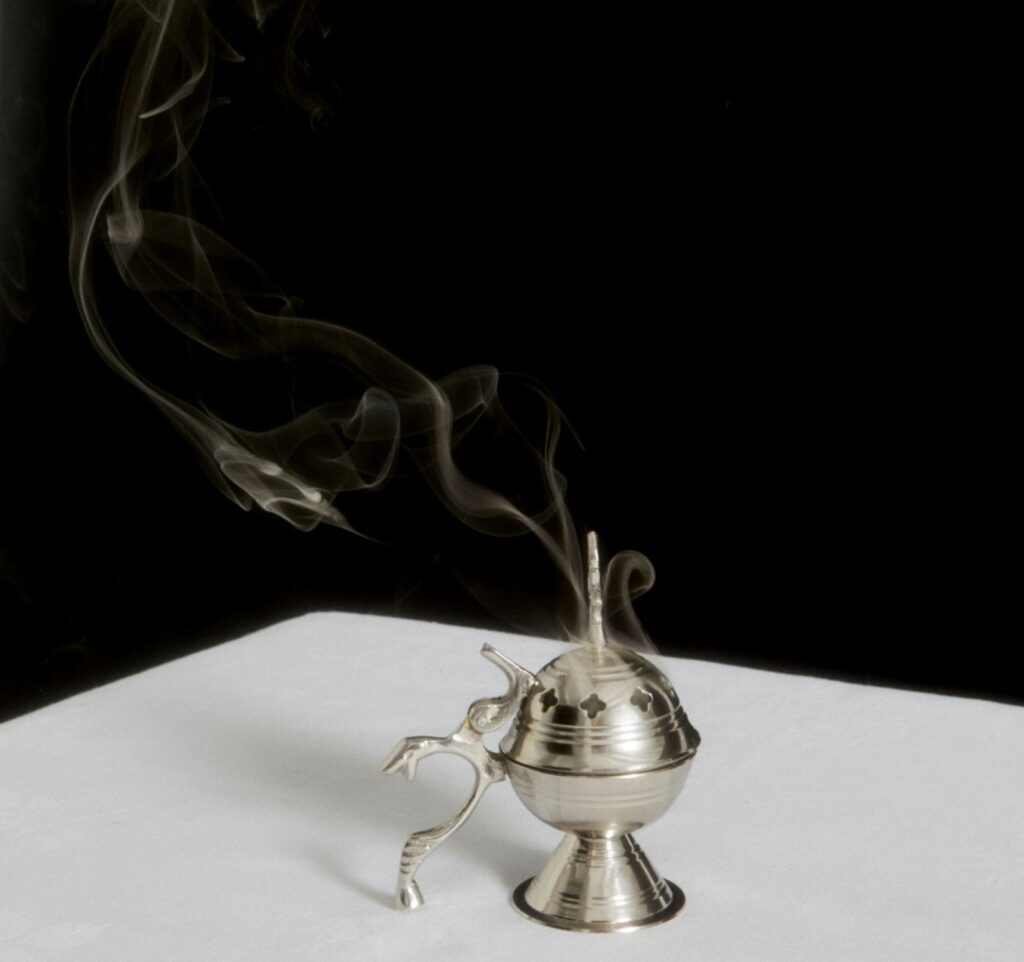
What is fascinating is that, although each culture uses different materials and develops its own rituals, they all seem to share the same intuition: aroma has the ability to alter our perception of a space before anything else even happens. Long before architecture, decoration, or lighting defined an atmosphere, smoke was already capable of doing so.
The Sense That Never Forgets
Science has begun to explain what different cultures intuited thousands of years ago. Unlike sight or hearing, smell maintains a direct connection with the limbic system, the region of the brain responsible for processing emotions, memory, and learning; this particularity makes scent one of the most powerful stimuli for awakening memories. A perfume, a wood, or a resin can immediately transport us to our grandparents’ kitchen, a church from childhood, or a house we have not returned to in decades.
When an Aroma Becomes a Memory
Neuroscientists know this phenomenon as the Proust effect, inspired by the French writer Marcel Proust, who masterfully described how the aroma of a madeleine dipped in tea could reconstruct an entire universe of memories. Since then, numerous studies have shown that memories evoked by smells tend to be more intense and emotionally significant than those activated by images or sounds.
Perhaps that is why aromas occupy such a special place in our everyday lives. We remember a person’s perfume long after forgetting their clothes; we preserve the smell of a house in our memory even when we can no longer reconstruct every piece of furniture within it. Spaces also possess an olfactory identity, although we are rarely fully aware of it.