
There are questions that don’t seem like questions, but change everything. “Are you still as committed now that you’re a mother?” doesn’t need to be aggressive to mark a before and after. Until that moment, commitment was not in question. After that, it begins to be observed, measured, interpreted under a different logic.
Author: Claudia Valdez
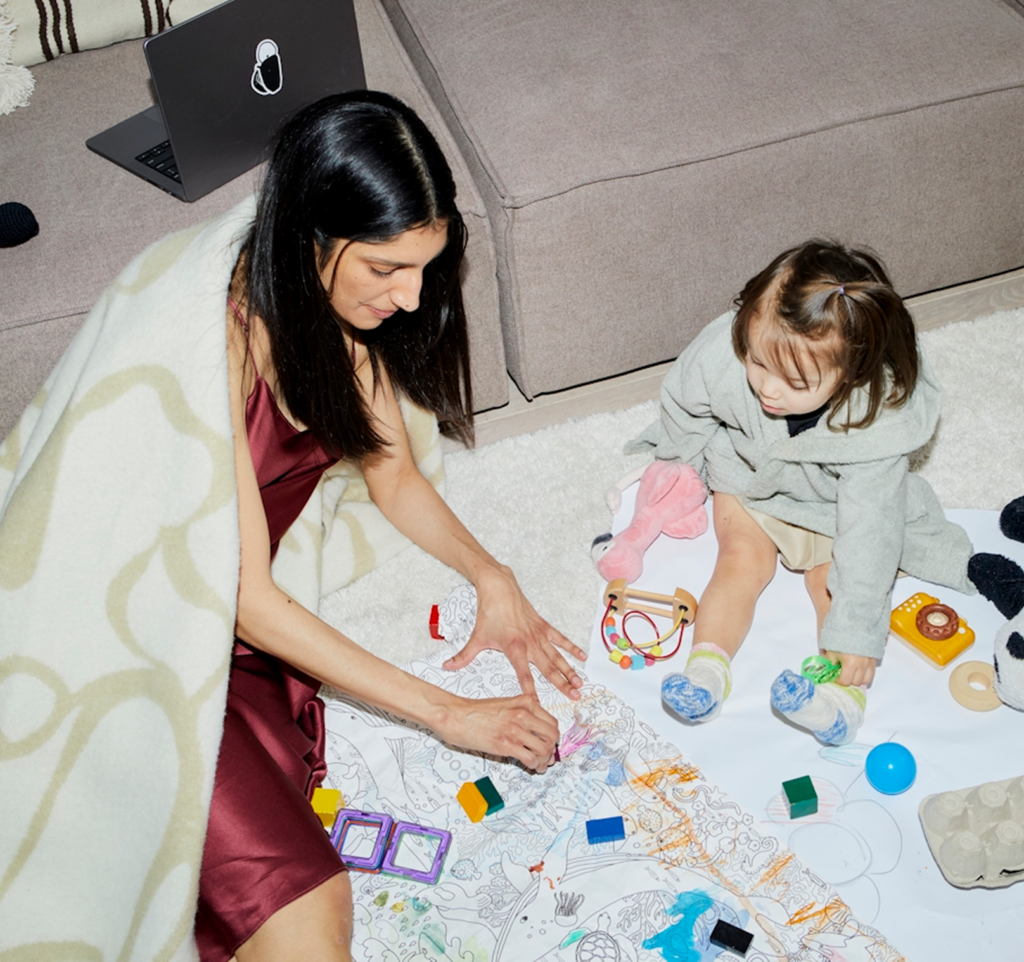
When the narrative changes, even if performance doesn’t
This is not an isolated case. It is a pattern that repeats itself with almost identical variations. Women who return from leave and discover that their place still exists, but no longer fully belongs to them. Others who never asked for adjustments, who even increased their effort, and still began to perceive a subtle distance: less inclusion in decisions, less visibility, less certainty in how they are perceived.
Not because their performance changed, but because the narrative around them did. What is rarely said is that motherhood not only reconfigures the life of the woman experiencing it, but also the dynamics of those around her. In work environments designed around constant availability, any adjustment can be perceived as a disruption of balance.
Becoming a mother does not change a woman’s capacity, but it does activate a series of perceptions that redefine how she is evaluated, read, and limited within the workplace.
What data has been confirming for years
Economist Claudia Goldin has documented that the gender pay gap is not distributed evenly, but intensifies after motherhood.
The so-called motherhood penalty implies estimated income reductions between 5% and 20%, as well as a decrease in growth opportunities and a constant reevaluation of commitment.
Research published in American Sociological Review has shown that, when presented with identical profiles, mothers are perceived as less competent and less available, while fathers are evaluated as more committed.
It is not a question of capacity, it is bias.
The psychological impact that goes unnamed
This phenomenon does not remain on the surface, it is internalized.
Psychology explains it as stereotype threat: when a person knows they may be evaluated under a prejudice, their behavior changes.
She overperforms.
She self-corrects.
She becomes more cautious.
She works more, but feels less sufficient.
And in that process, something begins to erode: confidence, spontaneity, the relationship with her own professional identity.


The so-called motherhood penalty implies estimated income reductions between 5% and 20%
The uncomfortable tension within the environment
Many of these tensions do not come only from hierarchies, but from the environment itself. When there are no clear policies, the adjustments a mother negotiates can be perceived as a disruption of balance. That friction is not exclusive to one gender. It emerges in systems where availability remains the standard, and where there is no structure, comparison appears.
Reports from McKinsey show that these tensions increase when workload is not clearly distributed. No one is wrong in how they feel, but the system does fail.
The cumulative (and silent) cost
The impact is not only emotional, it is structural.
Data from the International Labour Organization shows that motherhood is associated with lower female labor participation. Not due to lack of ambition, but due to lack of sustainable conditions.
This translates into lower income, less economic independence, and less access to decision-making spaces. But there is something harder to measure: women who begin to aspire less, ask for less, occupy less space, and many decisions that seem personal are not, such as reducing hours, changing roles, or leaving the workforce.
It is not a lack of ambition, it is wear. It is not that capacity has diminished,
it is not that commitment has disappeared, it is that the environment stopped being compatible.

What can actually change the conversation
The solution is not to demand more individual resilience.
It lies in redefining the system.
- Flexibility cannot be a negotiated privilege
- Productivity cannot be measured by presence
- Workload cannot remain invisible
And although change has begun, it is still not enough.
Today there are more policies, more conversation, and more awareness. But a policy changes nothing if using it has a cost, and that is where the question stops being individual.
“It is not about how resilient a woman can be, it is about how willing the system is to change.”
Because yes, change is underway, but it is still not guaranteed.
Because many times, the woman who seems less present is, in reality, the one holding the most.
Closing
Because the system that questions mothers today is the same one that depends on them. Perhaps change does not begin in grand speeches, but in something more uncomfortable: stopping interpretation from what is visible and beginning to understand what is invisible.
Because many times, the woman who seems less present is, in reality, the one holding the most.