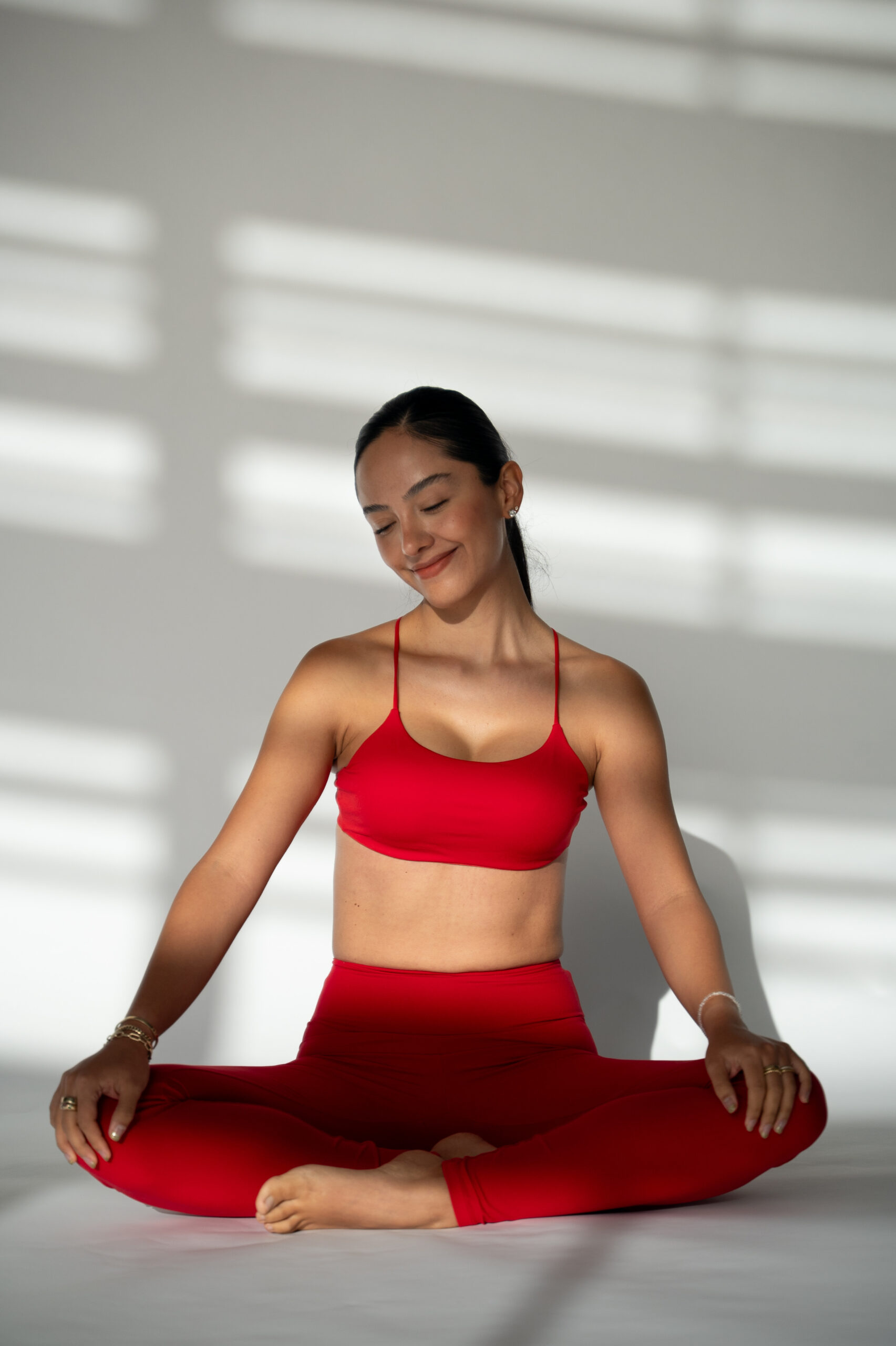
Karen Cassis, a Mexican founder of KCBARRE, blends ballet, barre, and hypopressive training with a clear focus on alignment, deep activation, and sustained muscular endurance. With a background in Business and early experience in the corporate world before fully dedicating herself to wellness, her shift was not merely professional, it was a personal recalibration of what it means to inhabit the body with intention.
Author: Claudia Valdez
The Weight of More
Beyond the method itself, her work engages with an urgent cultural question: how do we train in an era that confuses intensity with effectiveness?
We live in a time of permanent high performance. The female body does not simply work; it carries layered demands, professional, social, aesthetic, emotional. According to Women in the Workplace by McKinsey & Lean In, women report higher levels of workplace burnout than men. That exhaustion is not only psychological. It is physiological.
Elevated cortisol. Fragmented sleep. Inadequate recovery.
In this context, more intensity does not always mean more health.“We were taught that strength means enduring. I learned that strength means sustaining.”
— Karen Cassis
KCBARRE is not designed to push the body toward collapse, but to reorganize it from the center outward. Ballet contributes postural awareness and strategic elongation. Barre builds muscular endurance without excessive joint impact. Hypopressive work activates the deep core through breath control and internal pressure regulation, strengthening stabilizing muscles often neglected in traditional training.
Sessions, structured in approximately 50-minute blocks, work the entire body through a progressive logic: strength, endurance, and flexibility coexist within a single sequence.
It is not about sweating more. It is about activating with intention.
Strength as Continuity, Not Spectacle
For years, female strength was framed as an aesthetic pursuit. Today, the conversation is more nuanced.
Research published in the Journal of the American College of Cardiology indicates that regular strength training can reduce cardiovascular risk by up to 30%. Longitudinal studies further show that muscle mass is one of the strongest predictors of longevity after age 40.
Behavior reflects this shift. Data from the American College of Sports Medicine indicates that nearly 70% of active women incorporate strength training at least twice per week, with the most significant growth occurring between ages 35 and 50.
Strength is no longer cosmetic. It is metabolic. Preventative. Foundational to long-term vitality.
For women, particularly after 35 or 40, progressive muscle loss impacts metabolism, bone density, and hormonal regulation. High-impact training layered on chronic stress can exacerbate imbalances rather than correct them.
That is where precision becomes more relevant than intensity.
KCBARRE prioritizes stability before explosiveness. Control before depletion. Conscious repetition before speed.
The Nervous System and Sustainable Performance
In the era of “no pain, no gain,” few conversations address the nervous system.
The female body responds to chronic stress with inflammation, hormonal disruption, and accumulated fatigue. Training without considering this context can perpetuate burnout cycles.
The integration of deep breathing within the method is not aesthetic detail, it is autonomic regulation. It is lowering hyperactivation before asking the body to perform again.
And that regulation affects not only physical strength, but mental clarity and sustained energy. Habit science reinforces this. Recent global fitness app data shows that more than 55% of workout app users worldwide are women, and those who remain active for more than eight weeks are up to three times more likely to sustain long-term change compared to those who drop off within the first month.
Consistency is the true measure of transformation. And consistency requires adaptability.
A Method Designed for Real Life
KCBARRE’s expansion into an app is not a digital trend response. It is a response to fragmented time.
Women with complex schedules, mothers, professionals, caregivers, or simply inhabitants of fast-paced cities, need flexible discipline without sacrificing technique. Bringing the method into the home allows continuity without dependency on commute or rigid scheduling.
Short or long sessions. Adjustable intensity. Technical integrity. It is not content volume. It is coherence translated into real life rhythm.
In a culture that celebrates extreme performance as moral virtue, choosing control over depletion can feel radical. But the strongest form of power is not always the loudest. Perhaps the revolution is not in how much you can push yourself, but in how long you can sustain yourself without breaking.