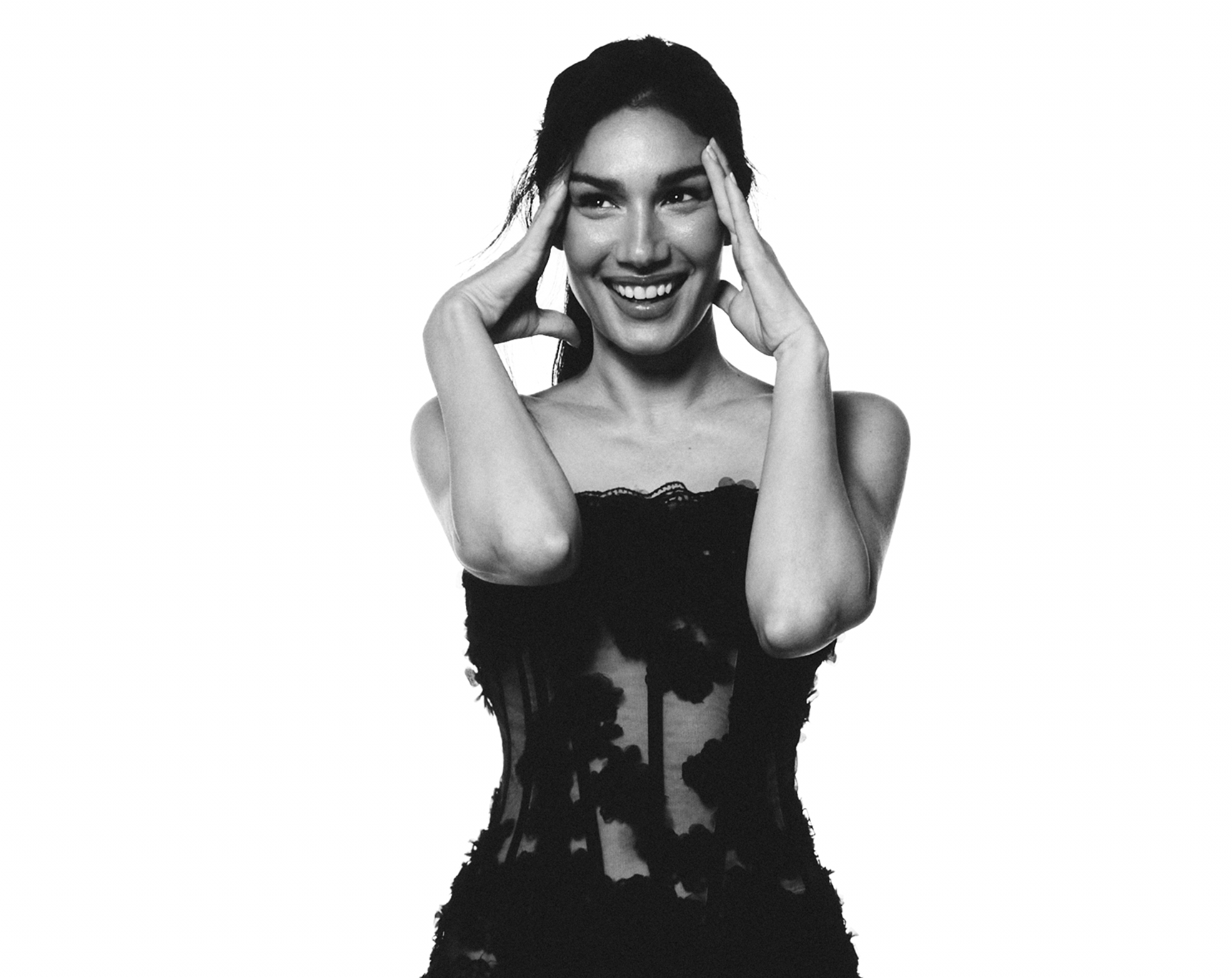
Being Latin. An identity that, now more than ever, reflects presence, visibility, and transformation. It’s often spoken of as something expanding, an identity that’s taking up space across art, film, and music. But amid that growth, it’s worth asking: what does it really mean to inhabit it?
Today, exclusively for Topics That Transform, Mariela Garriga reflects on her Latin roots, belonging, and what it means to be part of an industry that’s still redefining itself. Cuban-born and a well-established actress, Garriga has built a career that crosses borders. From Havana to Milan, and then to Mexico City, New York, and Los Angeles, her trajectory moves through contexts, languages, and ways of relating to her identity.
Author: aNDREA BAU
Mariela Garriga, Beyond the Journey
The conversation with Mariela flows much like her trajectory in the film industry: with certainty. She was born in Havana, where she began working in theater and television as a teenager. It wasn’t until 2009 that she made a decisive leap and moved to Milan, Italy. That’s where her career took off in European independent cinema, with projects like Gli Uomini d’Oro. Her next step was New York. And with it, a shift in scale. One that didn’t just mean moving cities, but entering a different industry, a different language, and a different way of building a career.
Still, her trajectory isn’t only defined by geography, but by the way she has positioned herself in every place she’s entered. “I never think about who I am to be where I am,” she says, almost as a way of distancing herself from the narrative so often imposed on Latin talent. Even so, she acknowledges that moving through this industry also involves another task: “I’ve had to educate the people I work with,” she explains. Not from a forced place, but from an organic one.
“We educate without being teachers, without saying, ‘I’m going to teach you who I am,’ but by sharing our experiences,” she says. It’s a process she sees as something built slowly, with every project, in every space. And she sums it up in an idea that runs through the entire conversation: that the world should understand who we are, what we do, and what being Latin really looks like. “At the end of the day, that’s what it’s about: for the world to understand who we are, what we do, and how being Latin is actually lived.”

“At the end of the day, that’s what it’s about: for the world to understand who we are, what we do, and how being Latin is actually lived.”
MARIELA GARRIGA
Mexico: Where Everything Makes Sense
For many years, that connection to what was hers wasn’t fully present. “It was asleep,” she admits when asked about her relationship with her roots. Moving to Europe meant learning another language, adapting to another culture, and little by little, leaving her own behind. “I wasn’t speaking Spanish, I wasn’t eating my food… I started to drift away,” she recalls.
And yet, as one of the loveliest surprises in our conversation, it was in Mexico that that distance began to shift. When she accepted a small role in Luis Miguel, la serie something clicked. “I felt so good working in my language, I felt free,” Mariela says. It wasn’t just the Spanish, but everything that came with it: the ease of understanding one another without explanation, the closeness to Latin American culture, and the familiarity of it all. “They understand me more. Not just the language, but body language, an expression… it feels so familiar.”
It wasn’t only a reconnection, it was also a decision. Garriga began seeking out projects in Spanish. “I want to work more in my language, with my people,” she says. Because, as she puts it, “when you do things you identify with, it gives you life.” Her love for Mexico is what marked that reconnection.
Being Latin, Beyond the Stigma
Perhaps what stands out most about speaking with the Cuban actress is the conviction with which she speaks about Latin talent, her interest in creating more space, and her loyalty to her roots. For her, moving through this industry means confronting deeply stigmatized ideas: contradictions around the foreigner, limited perceptions of her abilities, and a language that doesn’t always reflect the reality of the person speaking it.
“A lot of the time, when you come from Latin America, you’re ‘the pretty girl who doesn’t know how to do anything,’” she says. “We come in all colors, all kinds. Latin America is a mix of ethnicities,” she adds, putting forward a complexity that rarely makes it onto the screen.
More than a critique, Garriga sees it as a reason to rethink the way stories are told. “There need to be more Latin leads,” she says with conviction when asked what still needs to happen to confront that stigma. “Sometimes we’re the co-stars, but it’s not our story.” It’s not enough to be there, you have to be at the center of the narrative.

“I want to work more in my language, with my people, when you do things you identify with, it gives you life”
MARIELA GARRIGA
Between Projects and Decisions
If anything is clear throughout the conversation with Garriga, it’s that her projects aren’t driven by opportunity alone, but by a clear intention to choose from where she wants to build herself within the industry. She’s currently promoting Zeta, a Spanish project directed by Dani de la Torre for Prime Video, where she stars alongside Mario Casas. Although the scale of the production and the weight of the cast are undeniable, she makes it clear that what drew her in wasn’t just the structure of the script, but the place from which her character was built. “I was surprised to see a woman with her own agenda, not the typical supporting figure,” she says.
That same mindset carries into her experience in Mission Impossible. Working alongside Tom Cruise didn’t just mean becoming part of one of cinema’s biggest — and most beloved — franchises, it also meant understanding the industry from a different place, beyond acting itself. “I felt like I gained 30 years of experience in two and a half,” she explains. Not through acting alone, but through everything happening around it: production, dialogue with the team, and clarity in decision-making. “I learned not to wait for opportunities, but to go after them.”
It was that same drive that led her to take on one of the most complex challenges of her career: portraying Mary Magdalene in The Resurrection of the Christ, directed by acclaimed filmmaker Mel Gibson. “It scared me,” she admits. Not because of the scale of the project, but because of the historical weight of the figure. “She’s a very complex figure and, many times, misunderstood.”
She isolated herself, researched, and tried to approach the role from a place of her own in order to do justice to a story that, like so many others, has been read from a single perspective. Not to replicate a version, but to build it from her own reading. With pride, she says working with Gibson has been a privilege, and makes it clear that The Resurrection of the Christ, set to premiere sometime in 2027, will be “simply epic.”

Epilogue, in Mariela Garriga’s Key
Speaking with Garriga goes beyond format. It becomes a masterclass in intuition, conviction, and decision-making that redefines what it means to build a career in this industry. It shows that when it comes to building a career, it’s not enough to arrive, you also have to sustain yourself through what you do with every opportunity.
When asked what advice she would give the next generation of Latin actresses, her response isn’t immediate, but it is emphatic. “Look, look, and keep looking. Proactivity,” she says. “Don’t wait for opportunities to come to you. Go out and find them. Build a team, question things, say what you want, and above all, learn from everything…” Because in the end, it’s not about waiting for a place, it’s about building one.